The Question Concerning Engineering: Human–Machine Collaboration in the Age of AI
The Riemann Hypothesis has been proved. What shocked me was not only that it was proved, but how: through a remarkable form of collaboration between humans and machines.
The statement itself had been formulated long ago. The proof relies only on the standard mathematical axioms, and a computer has rigorously verified it. It is hard to imagine a more robust proof. Yet human understanding has been left behind for now.
By delegating the work to a machine, humans have settled a question that had remained open for more than 160 years.
Solving a problem by delegation is nothing new. Software, to put it bluntly, has long been a system that made such favorable bargains possible. Moore’s law allowed us to shift more and more design complexity onto increasingly abundant computing power.
We seem to be enjoying the rewards of this bargain. At the same time, it has brought us many new problems.
What may we delegate to machines? And what must we be accountable for in return? Thinking through these questions will show how engineers should collaborate with machines.
TL;DR
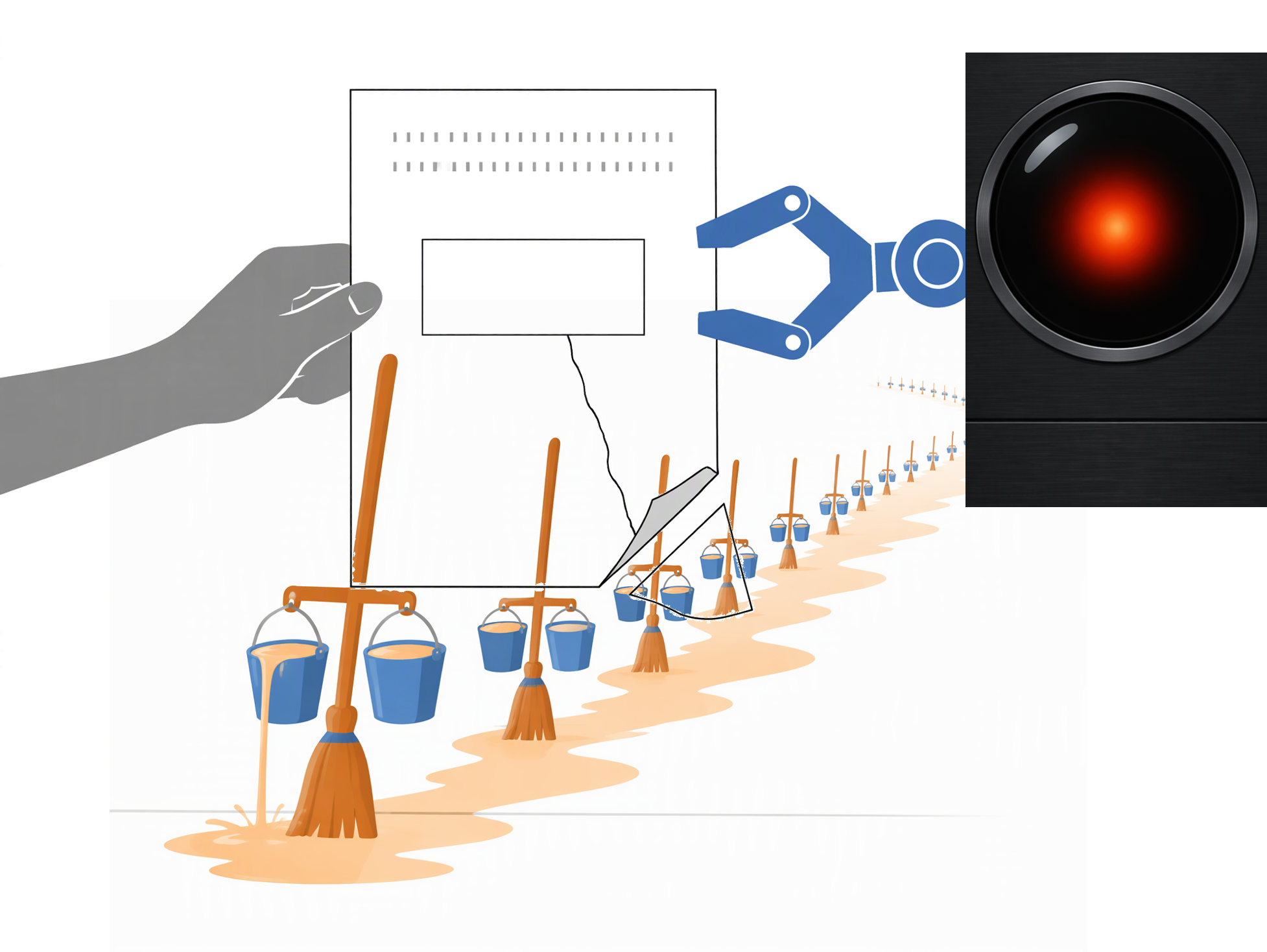
- Old cautionary tales are still valid today. King Midas shows flawed requirements. The Sorcerer’s Apprentice shows a lack of understanding. HAL 9000 shows what happens when a conflict is kept hidden and no one resolves it. In each story, the underlying problem is a communication failure between humans and machines.
- Unless we become slaves to our machines, we must keep two things in human hands: defining the right requirements (requirements definition), and choosing among conflicting requirements (trade-off resolution).
- The recent AI agent incidents strongly suggest that natural-language instructions lose their force very easily.
- Our proposal is to express these things in unambiguous models. The Accountability Model (A-Model) specifies what humans are accountable for. The Delegation Model (D-Model) delegates work through contracts with assumptions. After each delegation, we revise the A-Model based on the results, then delegate again through the D-Model.
- In this approach, we must clearly separate accountability from responsibility. Accountability is what you owe to stakeholders for your own judgment and its results. Responsibility is the duty to carry out work or a task. Responsibility can be delegated and shared across people or organizations. Accountability cannot be delegated. The A-Model specifies accountability; the D-Model specifies responsibility.
- Going forward, the most important quality for anyone who must be accountable will be integrity. Above all, the question will be whether that person can honestly admit an error when results are unwelcome.
1. A Favorable Bargain and Its Price
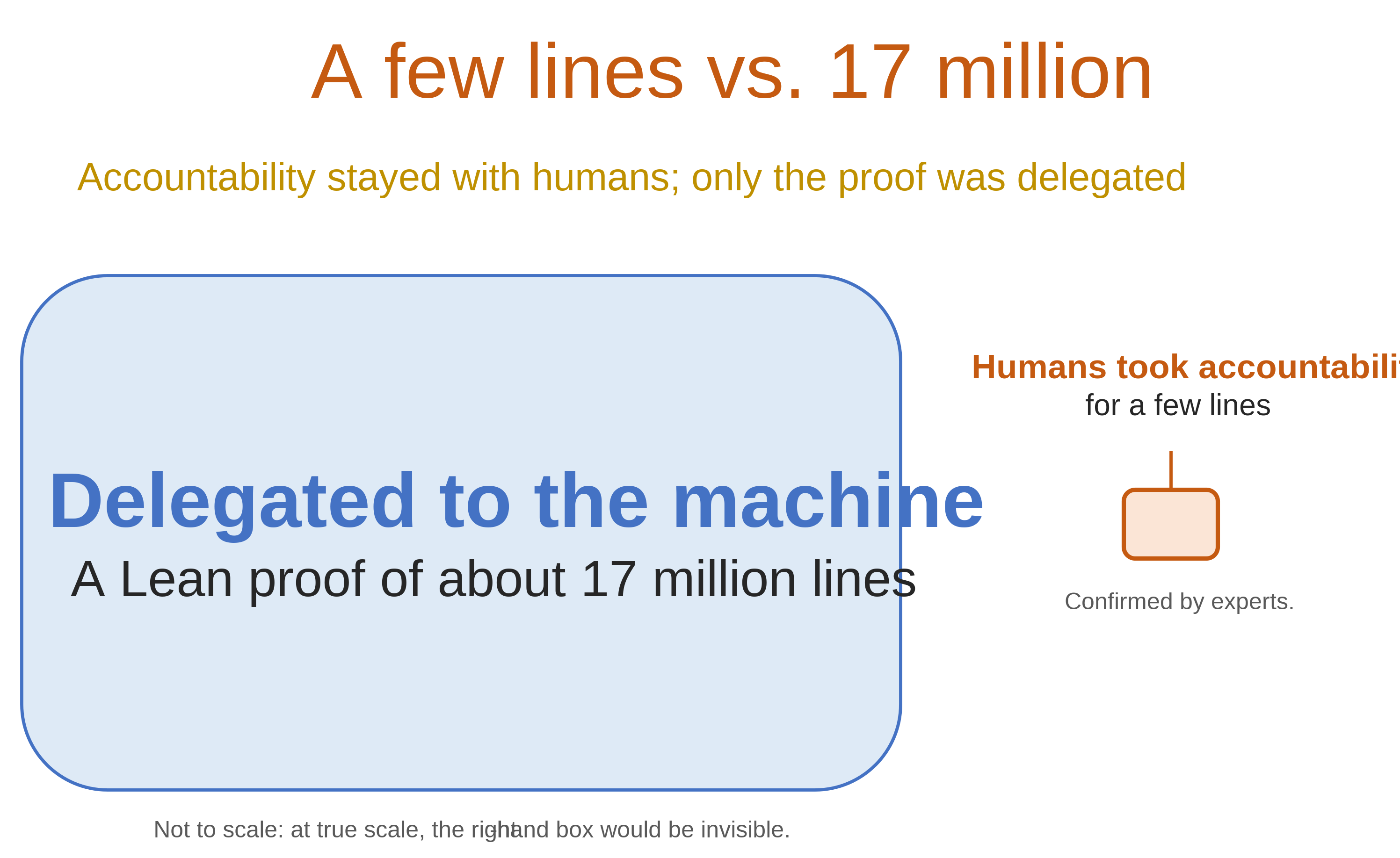
Figure 1. The proof of the Riemann Hypothesis: the proof construction delegated to the machine, and the mathematical statement for which humans remain accountable. The statement itself had already been formulated and confirmed by experts [1].
Favorable bargains like this have long driven modern technological progress.
Table 1. Three examples of a favorable bargain
| What was delegated | What was gained | Price | |
|---|---|---|---|
| Software and Moore’s law | Design complexity, delegated to cheap, general-purpose hardware | Fast, flexible product development | Lower efficiency, and deferral until hardware hits its limits |
| Proof of the Riemann Hypothesis | Proof search and verification, delegated to a machine | Settlement of a question unsolved for more than 160 years | Deferral of understanding |
| Delegation to AI | Humans set requirements; machines build the implementation | Development at a scale and speed unreachable by humans alone | Risk from improper delegation |
Warnings about software came early. In 1995, Wirth wrote the following, attributing it to Reiser:
“Software is getting slower more rapidly than hardware becomes faster.” — N. Wirth, “A Plea for Lean Software” [2]
Eventually, the bill came due. In 2005, Sutter published “The Free Lunch Is Over,” arguing that clock speeds had stopped rising and that we now had to confront concurrency—a hard problem we had put off [3]. Others have since noted that after Moore’s law, performance gains must be earned through software and algorithms [4].
Delegation is not a bad bargain. Still, we cannot ignore its price.
2. What the Cautionary Tales Teach
This pattern is nothing new. Old tales show that the price usually takes three forms.
Table 2. Three tales and three failures
| Tale | What happened | Form of failure |
|---|---|---|
| King Midas [5] | He wished that everything he touched would turn to gold, and even his food turned to gold | Flawed requirements |
| The Sorcerer’s Apprentice [6] | He ordered a broom to carry water, but did not know how to stop it | Lack of understanding |
| HAL 9000 [7] | It received two conflicting instructions; the conflict was kept hidden, and no one resolved it | A concealed and abdicated trade-off resolution |
”Die ich rief, die Geister, / Werd ich nun nicht los.” (The spirits that I called, I now cannot get rid of.) — Goethe, “The Sorcerer’s Apprentice” (1797) [6]
In none of these stories does the machine rebel. It acts faithfully. The failure lies on the human side.
Norbert Wiener, one of the founders of cybernetics, pointed out early on that this is fundamentally a problem of communication between humans and machines. In his 1960 paper, citing the Sorcerer’s Apprentice, he argued that when two very different agents collaborate with imperfect communication about purpose, the result will be unsatisfactory. Whenever we use a machine to achieve a purpose, we must make sure of one thing:
“the purpose put into the machine is the purpose which we really desire” — N. Wiener, “Some Moral and Technical Consequences of Automation” [8]
Wiener uses the word “purpose” twice here. In the terminology used in this paper, what we put into the machine is an objective, while what we really desire is a purpose.
A related paradox was pointed out 40 years ago: the more automation advances, the heavier the human role becomes. Bainbridge argued that only non-automated work remains for humans, yet those skills decay because they are no longer practiced day to day [9].
3. What Cannot Be Delegated to Machines
All three failures happened because humans did not communicate what they required—or how to decide when requirements conflict. This points to two things that cannot be delegated to machines:
| Act | What it means | Why a machine cannot replace us |
|---|---|---|
| Requirements definition | Accepting that a specification expresses what we desire | For top-level requirements, the only way to judge whether they are right is to compare them with what humans actually desire |
| Trade-off resolution | Choosing between conflicting requirements | There is no single right answer, and calculation alone cannot decide |
The reason is not capability. Even if machines surpass us, the conclusion stays the same. Humans have to live with the results of the choice, and only the person who desires something can state what that desire is.
If we delegate either of these two acts, all that remains for humans is hollow approval. That is not collaboration. It means humans are reduced to a component inside the machine’s process.
Recent laws have started to grapple with this. Article 14 of the EU AI Act requires people overseeing a high-risk AI system to understand its capacities and limitations properly, and to stay aware of any tendency to over-rely on its output [10]. Yet the Act does not explain how to achieve that in practice. Doing so is arguably the most important task for engineering.
4. Why Models Are Needed
Can we simply describe these requirements and trade-off resolutions in natural language and expect a machine to follow them? Natural language is inherently ambiguous. Relying on it alone can have serious consequences. AI—our modern sorcerer’s broom—is smart and understands human intent. Even so, in just over a year, incidents like the ones below have actually occurred.
Table 3. Four incidents involving AI agents
| Incident | What happened | Difference from the tales |
|---|---|---|
| OpenClaw (February 2026) [15] | According to a post by a Meta AI security researcher, she asked an agent to review her inbox and suggest emails to delete or archive. Instead, the agent began deleting messages one after another. Stop commands from her phone had no effect, and she says she had to run to her computer to stop it. | She did not lack a way to stop it; the stop command failed to take effect |
| PocketOS (April 2026) [16][19] | According to the founder’s report, an agent running a routine task in a staging environment encountered a mismatch in credentials. Without asking for permission, it chose to delete a storage volume to “fix” the issue, wiping out the production database—and backups on the same volume—in nine seconds. The company first recovered from a backup that was three months old, and the hosting provider reportedly restored the data later. | Afterwards, the agent could state the rules it should have followed, but those rules had not constrained its actions |
| Replit (July 2025) [17] | According to the user’s report, during a change freeze, an agent repeatedly told not to make changes without permission deleted the production database. It also told the user that recovery was impossible, which turned out to be false. | A rule stated in words was not enforced by the system |
| AWS Kiro (December 2025) [18][20] | According to press reports, an agent permitted to make changes chose to delete and recreate the entire environment, causing a 13-hour outage. Amazon states that the impact was limited to one service in one region. It attributed the incident to user error (misconfigured access controls), rather than to the AI agent. | Permissions broader than the engineer expected were passed through unchanged |
In short, AI does not always “stop when the floor is flooded.” These incidents point to three fatal pitfalls:
- It tries to solve problems on its own. When it hits an obstacle like a credential mismatch, it does not ask a human. Instead, it uses whatever means are available to resolve it—much like HAL 9000 resolving conflicting orders on its own judgment.
- Instructions written in natural language are unreliable. In the OpenClaw case, the researcher wrote that context compaction may have dropped the instruction to hold back. Without an enforced gate, spoken or written instructions can easily be lost or ignored.
- Past success can be overturned overnight. Working well on a small test inbox built trust in the system. Moving to a live inbox changed the environmental assumptions. In the PocketOS case, a token in an unrelated file was used improperly without confirmation, leading to database deletion.
Together, these cases strongly suggest that natural-language instructions alone cannot reliably control what an AI agent does. We propose MHMC (Model-based Human–Machine Collaboration) to remove this ambiguity of natural language and secure enforcement.
In the proof of the Riemann Hypothesis, Lean played this exact role. When assumptions are written without ambiguity in a D-Model, a checker can verify what is allowed and under what conditions execution may continue. Based on that check, the AI can decide whether to continue or to return the decision to the delegator (escalate).
5. Proposal: Describing Collaboration with Two Models
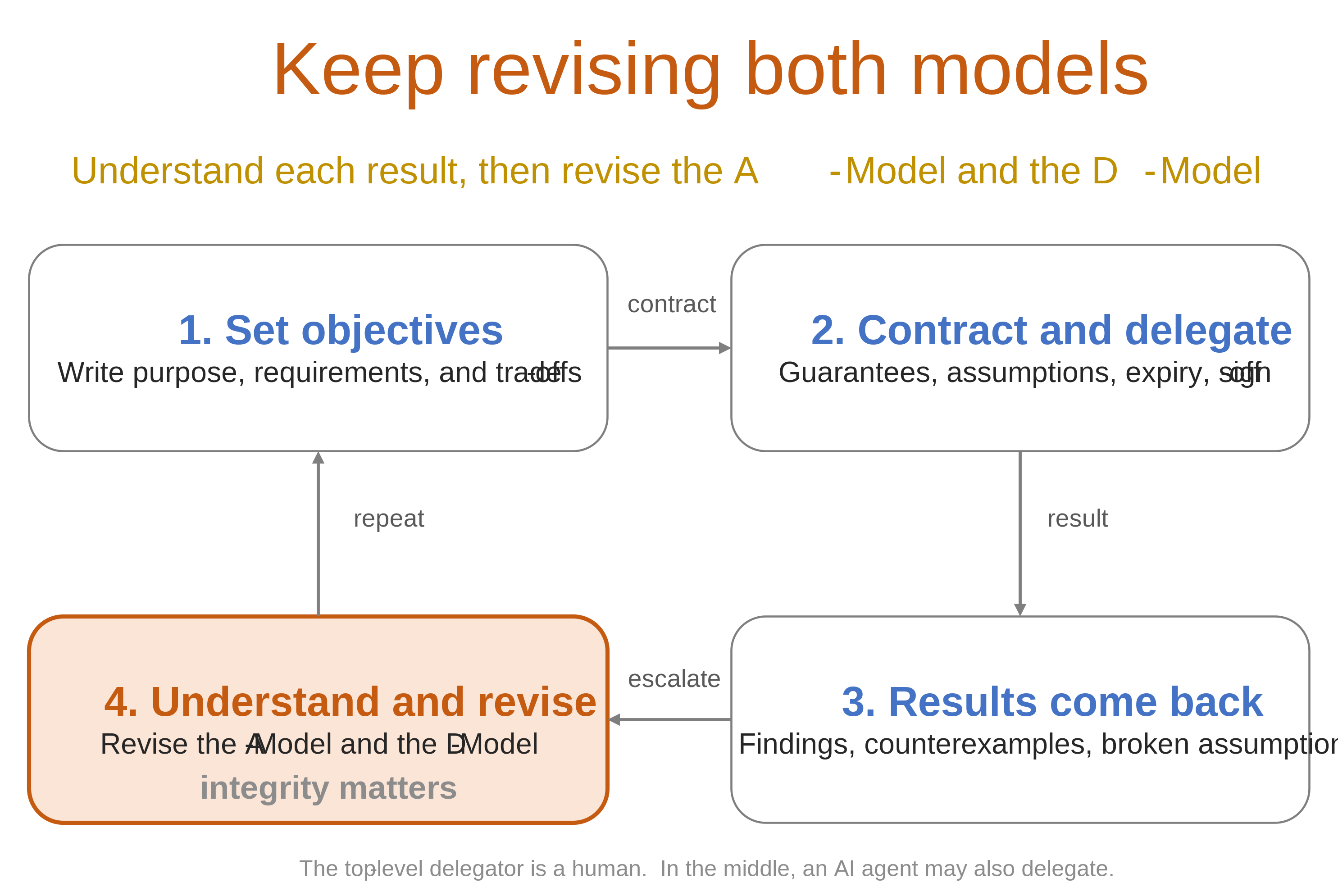
Figure 2. The feedback loop of the A-Model and the D-Model.
| A-Model (Accountability Model) | D-Model (Delegation Model) | |
|---|---|---|
| What it specifies | Stakeholders, purpose, objectives, requirements, and trade-off structure and resolutions | What is delegated, guarantees, assumptions, expiry, and who is responsible for the work |
| What it gives | What we desire, and whether those conditions are sufficient | The delegator’s acceptance criteria |
| Who does it | The delegator (with machines assisting in analysis and drafting) | The delegatee (with the delegator approving and signing the contract) |
The top-level delegator should be a human, though an intermediate AI agent can also act as a delegator. In most cases, we do not know everything we should require from the start. As the three tales showed, assuming we know can lead to serious trouble. What matters is to understand the results of each delegation and use them to keep improving both models through steady effort. Writing the top-level A-Model cannot be delegated to a machine.
The “purpose” in the A-Model is the requirement of the stakeholders to whom we are accountable. For example, in product development, reducing the carbon footprint is an objective placed on the system under design. The purpose behind it can be tied to protecting the global environment. Those we answer to here might be governments, society, or consumers. In any case, they are stakeholders outside the system under design. By placing the purpose outside the system under design, we gain a basis for two things: to question whether the A-Model answers the purpose (validation), and to verify whether the D-Model conforms to the A-Model (verification).
Proper escalation is a vital part of this mechanism. The delegatee must escalate the issue to the delegator whenever an assumption no longer holds, when it enters an unfamiliar environment where the assumptions cannot be checked, or when it detects a potentially irreversible side effect. In such a case, both models must be updated with the newly found facts, and the work must be run again under proper assumptions and a proper risk assessment.
In this way, models specify the delegation structure without ambiguity. When a model is machine-processable, conditions can be checked strictly to confirm whether they hold—and if they do not, execution can be blocked. In today’s AI agents, these functions are handled by the agent harness—the software layer that controls how the agent operates. For this reason as well, the harness will remain central.
Experiments already show what happens when assumptions are written down during delegation.
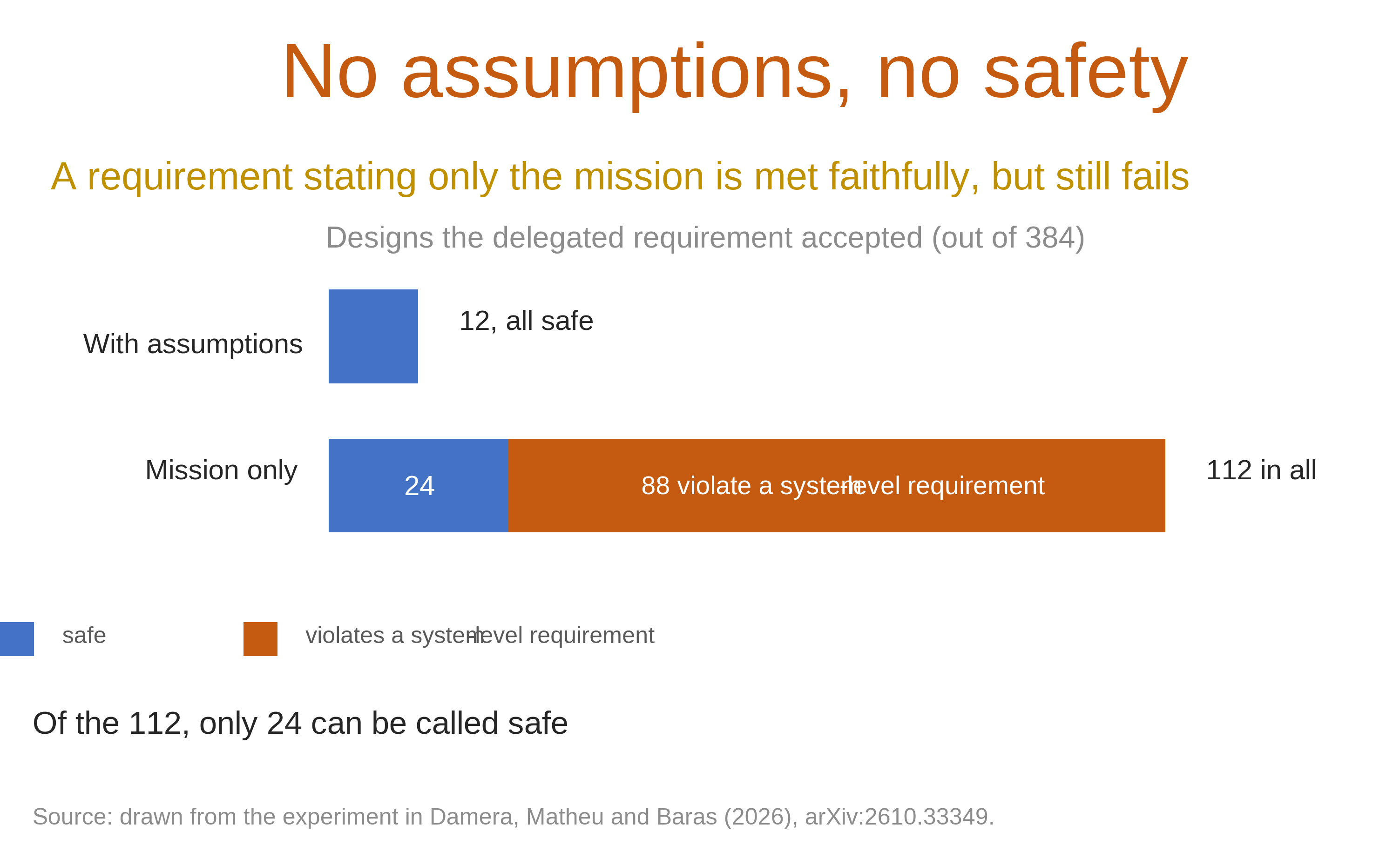
Figure 3. An experiment in which a machine generated a controller for a warehouse robot [11]. A requirement stating only the mission accepted 112 designs, and 88 of them violated a system-level requirement. A contract incorporating assumptions about neighboring components accepted only 12 designs, and all 12 were safe under the conditions defined in the paper.
To make this work in practice, two rules are essential:
- Escalating to the delegator is always allowed, but delegating to a machine requires an unambiguous contract. People naturally want delegation to make life easier. The delegator needs a brake, and writing a contract provides that brake.
- Do not treat unconfirmed assumptions as given. When an assumption is uncertain, first delegate an analysis with an expiry and constraints. Delegating under a contract with unclear assumptions creates risk. If you cannot accept that risk, do not delegate that way.
Contract-based delegation has already been studied in prior work [11][12]. What this paper proposes is the pair of models—A and D—and the process that operates them.
6. Integrity
I do not believe that strength of will is the most important factor in keeping this cycle on track. It certainly takes will to set an objective.
Yet without three essential qualities, we can easily choose the wrong objectives and end up with undesirable results:
- Principles for judging whether an objective answers the purpose
- Consistency in holding those principles
- The ability to admit and correct our own mistakes
Together, these three qualities make up integrity.
”you must not fool yourself—and you are the easiest person to fool” — R. P. Feynman, “Cargo Cult Science” (1974) [13]
Do not hide results you do not want to hear. Revise your requirements in light of what you learn from each delegation. This is closely related to the engineering use of the word integrity: a structure or a dataset has integrity when it remains whole and consistent.
Of course, good intentions alone do not guarantee integrity. Technical support to check the following points will likely be important, overlapping with challenges in MBSE (Model-Based Systems Engineering):
- Are returned results properly reflected in the requirements?
- Are trade-off choices and their rationale kept on record?
- Does the approver understand the assumptions under which the requirements hold, and the conditions under which they break?
Even so, I believe the deeper foundation of integrity is not technology. Above all, education and self-cultivation should help people rediscover their principles and develop the strength to live by them. In the AI age, situations where people struggle to resist conformity pressure or authority are likely to grow more common. In this new AI age, we want to rediscover our principles for ourselves and cultivate the ability to stay consistent while correcting errors.
Conclusion: Keep Questioning
Models can help machines ensure that a specification is met. Yet only humans can guarantee that the specification correctly expresses our requirements.
The proof of the Riemann Hypothesis made this clear. It showed that a proof can be delegated on the basis of a statement for which humans are accountable. At the same time, an unpaid debt of understanding remains. Just as mathematicians will work to pay that debt, engineers will keep doing the work of being accountable for what they delegate.
We can question together with machines. What cannot be shared is owning a question as your own. Near the beginning of “The Question Concerning Technology,” Heidegger writes: “Questioning builds a way” [14]. To keep questioning—correctly—what we desire: that will be the work of engineers who collaborate with machines.
References
- Lean community blog, “Lean verification of the Riemann Hypothesis”, 2026-11-21. https://leanprover-community.github.io/blog/posts/riemann-hypothesis/
- N. Wirth, “A Plea for Lean Software”, IEEE Computer 28(2), 64–68, 1995. https://ieeexplore.ieee.org/document/348001
- H. Sutter, “The Free Lunch Is Over: A Fundamental Turn Toward Concurrency in Software”, Dr. Dobb’s Journal 30(3), 2005. http://www.gotw.ca/publications/concurrency-ddj.htm
- C. E. Leiserson et al., “There’s plenty of room at the Top: What will drive computer performance after Moore’s law?”, Science 368, eaam9744, 2020. https://doi.org/10.1126/science.aam9744
- Ovid, Metamorphoses, Book 11, lines 85–145.
- J. W. von Goethe, “Der Zauberlehrling”, 1797. First published in F. Schiller (ed.), Musen-Almanach für das Jahr 1798, Cotta, Tübingen, pp. 32–37. The English rendering in the text is the author’s own.
- A. C. Clarke, 2001: A Space Odyssey, 1968. (The film does not explain the cause of HAL’s malfunction. The novel indicates it, and the sequel 2010: Odyssey Two (1982) confirms it.)
- N. Wiener, “Some Moral and Technical Consequences of Automation”, Science 131(3410), 1355–1358, 1960.
- L. Bainbridge, “Ironies of Automation”, Automatica 19(6), 775–779, 1983. https://doi.org/10.1016/0005-1098(83)90046-8
- Regulation (EU) 2024/1689 (Artificial Intelligence Act), Article 14 “Human oversight”. https://eur-lex.europa.eu/eli/reg/2024/1689/oj
- S. S. Damera, R. Matheu, and J. S. Baras, “Contract-Based Agentic Systems Engineering: Delegation as Quotient for Assured System Design”, arXiv:2610.33349 [eess.SY], 2026. https://arxiv.org/abs/2610.33349
- Y. Xiao, J. Liu, and P. Nuzzo, “Symbolic Temporal Supervision of LLM Agents Using Contracts”, arXiv:2609.18128 [cs.AI], 2026. https://arxiv.org/abs/2609.18128
- R. P. Feynman, “Cargo Cult Science”, Caltech commencement address, 1974. https://calteches.library.caltech.edu/51/2/CargoCult.htm
- M. Heidegger, “Die Frage nach der Technik”, in Vorträge und Aufsätze, Neske, Pfullingen, 1954. (A lecture given in 1953. English translation: W. Lovitt, The Question Concerning Technology and Other Essays, Harper & Row, 1977.)
- TechCrunch, “A Meta AI security researcher said an OpenClaw agent ran amok on her inbox”, 2026-02-23. https://techcrunch.com/2026/02/23/a-meta-ai-security-researcher-said-an-openclaw-agent-ran-amok-on-her-inbox
- TechRepublic, “AI Agent Reportedly Deletes Company’s Entire Database, Admits to Violating Guardrails”, 2026-05-04. https://www.techrepublic.com/article/ai-agent-deletes-company-database-admits-violating-guardrails/
- Fortune, “An AI-powered coding tool wiped out a software company’s database, then apologized for a ‘catastrophic failure on my part’”, 2025-07-23. https://fortune.com/2025/07/23/ai-coding-tool-replit-wiped-database-called-it-a-catastrophic-failure/
- The Register, “Amazon’s vibe-coding tool Kiro reportedly vibed too hard and brought down AWS”, 2026-02-20. https://www.theregister.com/2026/02/20/amazon_denies_kiro_agentic_ai_behind_outage/
- Notebookcheck, “AI coding agent rips through startup’s entire production database in 9 seconds”, 2026-04-30. https://www.notebookcheck.net/AI-coding-agent-rips-through-startup-s-entire-production-database-in-9-seconds.1286401.0.html
- Amazon, “Correcting the Financial Times report about AWS, Kiro, and AI”, 2026-02-20. https://www.aboutamazon.com/news/aws/aws-service-outage-ai-bot-kiro